Creation
What is Creation? How can we understand the world around us? How can we have a harmonious relationship with creation? These are very old questions with very complicated answers. The simple, but hopefully not simplistic answer is that Creation is the scope of all existing things. Plants, birds, trees, land, water, the solar system, black holes, time, friendships, and language are all examples of created things. Although it may not be obvious how all of those existing things come from God, it is enough to say that they originate from God. The point of this post is not to go through every possible existing thing and prove that its origin resides in God. With simple logic we can conclude that if God is the principle of all things, including instrumental causes, then it is enough to say that He is the first cause of all causes that exist i.e. existing things in the world, both physical and non-physical.
God speaks creation into existence by His own power. In His creating act, there is order and goodness. It cannot be otherwise. God is in fact order itself, I would say. If God is order itself, and He brings into existence something distinct from His nature, I think we can say that that particular, created thing has an orderly characteristic “embedded” within its own nature. I recognize that these ideas are saturated with layers of philosophical complexity and would require in-depth research with specific primary and secondary sources. However, for the purposes of this blog post, it is enough to say that all physically created things come from God and have some “imprint” of his nature grafted onto theirs.
According to Wisdom 11:20, “You have arranged all things by measure and number and weight.” God as the Creator, the uncaused cause of all causes that exist, and the source of all order in creation leads us to speculate on the exact nature of this order. It was the “image of the invisible God”, Col 1:15, the logos, wisdom, by which creation came into existence and exists. The human person has access to this wisdom by virtue of being made in the image and likeness of God. God creates things in and by “order”; God creates the human person in His “image and likeness”; therefore, the human person is capax Dei sapientia, which means, he can see the ordered wisdom of God in creation. This vision is obviously diminished because of Original Sin but nevertheless, we still have some capacity. Essentially, the person who was matter, “from the dust of the ground”,Genesis 2:7, was given the capacity to see by the faculties of his form: the soul.
The human mind is a vehicle for cognitive apprehension which receives being, which comes from the creative logos of God. What it means to be a creation means to be always receptive to being/essence of a divine source (Josef Peiper, “Faith, Hope and Love”, pg. 61-63). The human person, being created, has the capacity to receive the rest of Creation, thereby exercising his receptivity. As having a special quality of being made in the image of God, we can actively engage in reasoning with Creation. We do this in many ways, but one unique way is through Mathematics.
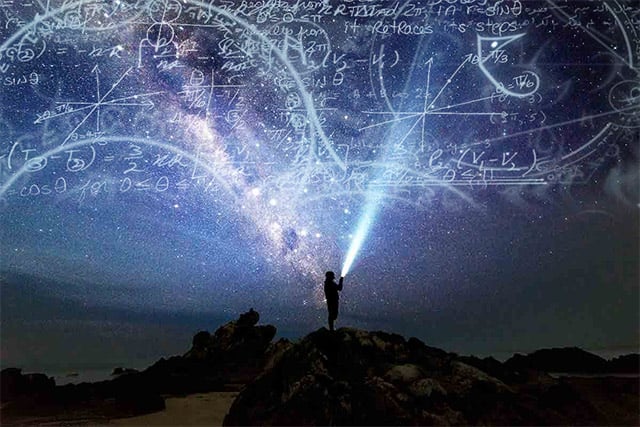
Creation, logos, Mathematics:
In the first chapter of the Gospel of John, we find a unique claim by the author: “All things came to be through him, and without him nothing came to be.” (Jn 1:3). The logos, word or reason, plays a necessary role in things coming to be or existing. The entirety of ordered creation came to be through the logos. The Word of God, made flesh in Jesus Christ, comes to reveal the fullness of God. He enters his own creation. The ordered structure of the world from the beginning of creation has continued to the present moment with the creative logos at its center still. When seen in this context, creation shines with divine light and allows the mind of man to partake in the creative order through many vessels, one of which is mathematical abstraction.
Considering these general premises of Creation, we can ask ourselves how mathematical axioms and postulates, whether Geometric or Algebraic, fit or exist within physical Creation. Given the fact that every physical thing in the universe has some degree of measurement we can conclude that in the creative act, quantity and shape are necessary accidents to any substance. Since every physical thing has an element of quantity, we might be able to say that our human engagement with quantity or shape is a direct engagement with the logos, through which creation exists. I would say especially that the mathematical order latent within the physical world is a most direct way to for that human engagement. The peculiar thing about these mathematical realities is that we have the intellectual capacity to manipulate them in such a way as to be participants in the continued work of Creation, even though we often discover these realities by accident.
This capacity of the human being to engage in nature, in such a tangible way, through mathematics, is certainly unique to the human person. Mathematics seems to be a special divine signature imprinted on Creation itself, without which Creation would be truly left “void and without form”.
 The Catholic Tutor