The Catholic Tutor

A place for Catholic intellectual topics.

My blog is a Catholic intellectual commentary on any field of knowledge from Philosophy, Mathematics, Science, History, Literature and Politics.

  • Foundational Metaphysics: Importance of order

    The most foundational thing a human person can accept is the existence of things (objects) in the world. Barring any psychological anomalies, a human person, by default, notices that he/she is contained within a physical structure we call “body”. At the same “moment” the human person distinguishes between that “body” and individuated objects in the world. I’m using the term “world” referring to anything that is not a person’s physical body. This is an axiom. Something that is already established and has no need of proof. It is self-evident. Some logicians might claim that there is no such thing as self-evident declarations but this has never been the case in the history of knowledge and learning. From the ancient world, there were certain things that were accepted as true and unable to be challenged in a rigorous sense. Euclid even needed to start somewhere, which is why he laid out his five axioms before he moved to his postulates and propositions. For example, “The whole is greater than its parts.” A baby can tell if one thing is bigger than another. 

    If one can see the latent and obvious order that exists in the world, one is not far from asking the question, “How do I understand the world?” If there is an order to existence, then an ordered mode by which we encounter the world must exist. Babies and young children encounter their experiences of the world. They receive the things in existence through their senses by picking up and grabbing objects. The desire to know those things seems obvious, even if they may not know why they may have a desire. This never goes away when human beings grow up, it just changes and the encounters with existing things, and thoughts, become more complex. 

    Starting from Aristotle and moving into the middle ages, there was an understood order of the sciences, which developed throughout those centuries and culminated in the 13th century with Theology as the queen of the sciences, then philosophy, then the practical sciences such as mathematics, medicine etc. Each of the sciences had their particular domain that was termed its “object”. Theology studies the most abstract thing, God. Philosophy the “next” abstract thing, wisdom. Mathematics is the science that deals with quantity. Although Mathematics still deals with quantity, numbers, lines and shapes, it also seems to study and examine the behavior of physical entities. This is why it is the languages and “queen of the physical/empirical sciences”. The medievals considered Logic as part of or fundamental to philosophical inquiry. Nowadays Logic can be studies from within the Mathematical field or the Philosophical field. For more on Mathematics, see a future post. 

    This medieval/ancient order of the sciences is still relevant today and should be considered in modern pedagogy. The order of the sciences does not intend to communicate the superiority between the various fields, in that one is “better” than the other. It merely gives an appropriate structure for the human mind to encounter Creation. Approaching an understanding of the world, Creation, a human person needs to have an ordered approach. At least an understanding of that order. 

    In summary, the order of the world automatically structures the order of learning. We distinguish objects in the world and approach them accordingly. This is a fundamental starting point. If we dismantle or approach this foundation with nihilistic world views, there is no moving forward in human formation. For the most part, the division of the fields of knowledge that existed in the ancient and medieval worlds still apply. It is possible to make some adjustments concerning the objects of the various sciences as the collective knowledge of the human race has grown. The main point is that all of the fields of knowledge have an intrinsic order as they relate to one another, and this order must be acknowledged and accepted for the human person to have a good pedagogical formation. 
  • The disjointing of education

    Current 21st century pedagogy is rooted in misplaced philosophy which stems partially from the Enlightenment period (1600-1700s) which sought to extrapolate knowledge of things by way of deconstruction and compartmentalization. In many overt ways, 21st century pedagogy is the developed Frankenstein of mad philosophers who seemed to have lusted over their desire to “overcome” the establishment and “overturn” long standing institutions of Catholic education. I’m thinking of Francis Bacon’s “The New Organon”, a direct jab at Aristotle’s “Organon”. It is the unfortunate case that modern pedagogical methods have seeped into the Catholic education system. The consistent devolution of the Catholic School system is caused by the subtle tentacles of secular philosophical pedagogy, which is categorically counter to the ordered realism found in the Catholic intellectual tradition with its center, the human person. Not only has disjointed educational theory dismantled, or is dismantling Catholic education, but also the socio-political environment pressuring individual schools to adopt unnatural anthropology causes genuine Catholic schools to rethink their future. 

    A wholistic pedagogy leads to a wholistic understanding of the world. How does one begin to understand the world so as to construct the necessary pedagogy? You start with what is real. How do we know what is real? You begin with certain axioms that you know are foundational to the world around us. For example, we interact with the world through our senses. Nevermind the complexity of how this happens (neurological perception etc), what all human beings notice immediately is that we interact with the world around us. People, places, things. 

    Generally speaking, Enlightenment philosophy, specifically Cartesianism (and before that Nominalism which questioned the existence of universals and abstract concepts), had the approach of deconstruction and compartmentalizing, which inevitably led to a compartmentalizing and deconstructing of teaching and learning. Everything has its own box, that does not and must not interfere with other boxes. Fast forward five hundred years and you have obscure specializations in every academic field imaginable with no common language between each other to communicate the meaning of the big picture. Not to mention each professional in these hyper-specialized fields thinks they have the key to the “one lock” that opens the door to understanding all things, when in fact they are all grabbing a different part of the same key pulling away from each other. 

    Not all Enlightenment thinkers were bad. Some of them had many good ideas and the philosophies of the Enlightenment were necessary for the mature development of humanity. Deconstructionism is not all bad. It is helpful to take something apart piece by piece to understand how it works. But this is for the purpose of understanding the functionality of a thing. When Theology seeks to understand God it does not “deconstruct” Him. In fact, it acknowledges that he is non-deconstructable. He is One. He is mystery. Theology starts with that and discovers what we cannot know in order to be left with what we can know. This is called theologica negativa or apophatic theology. 

    One of the effects of a deconstructionist educational philosophy is disintegration in the cohesive formation of a person. If order is not acknowledged as a fabric of connection between fields of knowledge, then how will the student journey through life in a non-chaotic way? If there is no order to what things shall be taught for the formation of a person, then any and all topics are seen as having the potential to “form” a person. Any brand new field of study tainted by the changing winds of society and propaganda could be seen as valid in forming a person. 

    I’m willing to propose that the unifying force of all things, the one “key” to the lock, that exists is the order that is present within those things and between them. Learning and pedagogy are the reception and the giving, respectively, of ordered existence. Any true pedagogy must have the goal of communicating the whole picture with all the necessary fabrics of the canvas beautifully interwoven and intrinsically connected to each other. This is why a re-discovery of classical pedagogical approaches, with a robust metaphysical foundation must be embraced.

  • Precious in the Sight of the Lord

    When I was notified of Charlie Kirk’s murder I was at my fulltime job, working on aircraft jet engines. In this type of job, it is very easy for me to zone out and focus on the task set before me. On September 10, 2025, I could not. As I was working to provide for my family, on a relatively secure site, another man was working in an apparently unsecure site, not only to provide for his family but to provide for a nation. Over a thousand miles from where I was a killer’s bullet took this man’s life. After I learned of Charlie’s murder I was filled with an intense rage. I could no longer focus on bolts, clamps and pressure tubes. My feelings of rage and sadness vacillated, with the thoughts of Holy Adoration and hunting the animal that took the life of a great man. I found myself pacing around not knowing how to handle these feelings. I still fully cannot understand them. I can really only write about them. 

    Although I didn’t know much about Charlie before his life was taken, I am now very aware of the impact he had on this nation. He was the bedrock of a strong and growing conservative movement and the new dynamic of the Republican party. He was the voice that young people needed in a time of immense confusion. Every video I have seen of Charlie debating or speaking the truth on a podcast has impressed me. He spoke clearly, truthfully, and many times in dangerous situations, as was proven on that tragic day at 12:23pm. 

    I never intended for this blog channel to “get political” or encourage one political party in particular. This is because I believe the truth of the Catholic church is beyond political parties. My goal was to have a very balanced approach to ideas that the Catholic church has expressed throughout her beautiful history. Ideas that secured the fabric of humanity and have kept us on track. Things like the truth of Scripture, virtue and most importantly the Most Holy Eucharist, which is the lifeline of the world, have guided the world towards Jesus Christ despite the horrors we do to each other.

    However, after Sept. 10th, there is no more balance. There is only Truth. The truth of which Charlie spoke, the truth of God and the truth that there is only one political party, or at the very least a subset of a political party, in America right now which succumbs to extreme violence. Why? Because they don’t have the Truth. Without the Truth, you have falsehood, which is rooted in the Father of lies. These demonic ideas, such as transgender ideology, critical race theory, hatred for family and children, and hatred for America, are the fabric of far-left extremism. 

    This blog cannot any longer be only about abstract beautiful ideas, but must also speak on how those ideas inform our political and cultural action in the midst of such extreme hatred. Charlie spoke of ideas that have their foundation in the very same things the Catholic church has preached throughout the centuries. Love for family, country, neighbors and all the dimensions of what it means to be pro-life from conception to natural death are all supremely Catholic beliefs. 

    Perhaps the greatest ideal that Charlie taught and ultimately died for was the freedom of speech. Freedom of speech is not merely something found in the Constitution of the United States. It is a critical dimension of the human soul, assuming that speech is genuine communication between two human beings. Why? Because speech is directly connected to the truth, in that speech allows the logos to be heard. All truth that is spoken concretely has its origin in God, who is eternal peace. Charlie knew this and lived by this ideal on college campuses, podcasts, interviews etc. He spoke openly and with anyone so that those ideas do not turn into violence. We might be tempted to think that violence silenced him but, on the contrary, he is speaking the truth stronger and louder than ever. The folly of our enemies is that they thought violence can overpower spoken truth. It cannot. It will never. 

    There are some that say now is a time for peace and unity among neighbors across different viewpoints. On the one hand there is truth in making peace and loving our neighbors more than we have before. On the other hand, there is a very real call for spiritual warfare, which requires us to not make peace with the Devil. Now is the time for holy action, holy words, and holy prayers. It is my belief that Catholics found a friend in Charlie. That friend was taken by the Devil. As Catholics we have incredible access to a heavenly army with weapons far stronger than ICBMs and faster than hypersonic cruise missiles. As Catholics, let us access them immediately! A holy war has descended upon us. May we use our nuclear triad of prayer, fasting and almsgiving to lay waste to our enemy.

  • Theology of Mathematics?

    Creation

    What is Creation? How can we understand the world around us? How can we have a harmonious relationship with creation? These are very old questions with very complicated answers. The simple, but hopefully not simplistic answer is that Creation is the scope of all existing things. Plants, birds, trees, land, water, the solar system, black holes, time, friendships, and language are all examples of created things. Although it may not be obvious how all of those existing things come from God, it is enough to say that they originate from God. The point of this post is not to go through every possible existing thing and prove that its origin resides in God. With simple logic we can conclude that if God is the principle of all things, including instrumental causes, then it is enough to say that He is the first cause of all causes that exist i.e. existing things in the world, both physical and non-physical.   

    God speaks creation into existence by His own power. In His creating act, there is order and goodness. It cannot be otherwise. God is in fact order itself, I would say. If God is order itself, and He brings into existence something distinct from His nature, I think we can say that that particular, created thing has an orderly characteristic “embedded” within its own nature. I recognize that these ideas are saturated with layers of philosophical complexity and would require in-depth research with specific primary and secondary sources. However, for the purposes of this blog post, it is enough to say that all physically created things come from God and have some “imprint” of his nature grafted onto theirs. 

    According to Wisdom 11:20, “You have arranged all things by measure and number and weight.” God as the Creator, the uncaused cause of all causes that exist, and the source of all order in creation leads us to speculate on the exact nature of this order. It was the “image of the invisible God”, Col 1:15, the logos, wisdom, by which creation came into existence and exists. The human person has access to this wisdom by virtue of being made in the image and likeness of God. God creates things in and by “order”; God creates the human person in His “image and likeness”; therefore, the human person is capax Dei sapientia, which means, he can see the ordered wisdom of God in creation. This vision is obviously diminished because of Original Sin but nevertheless, we still have some capacity. Essentially, the person who was matter, “from the dust of the ground”,Genesis 2:7, was given the capacity to see by the faculties of his form: the soul. 

    The human mind is a vehicle for cognitive apprehension which receives being, which comes from the creative logos of God. What it means to be a creation means to be always receptive to being/essence of a divine source (Josef Peiper, “Faith, Hope and Love”, pg. 61-63). The human person, being created, has the capacity to receive the rest of Creation, thereby exercising his receptivity. As having a special quality of being made in the image of God, we can actively engage in reasoning with Creation. We do this in many ways, but one unique way is through Mathematics. 

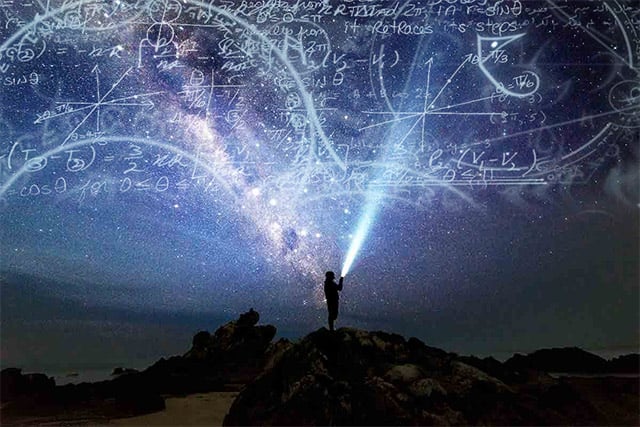
    Creation, logos, Mathematics:

    In the first chapter of the Gospel of John, we find a unique claim by the author: “All things came to be through him, and without him nothing came to be.” (Jn 1:3). The logos, word or reason, plays a necessary role in things coming to be or existing. The entirety of ordered creation came to be through the logos. The Word of God, made flesh in Jesus Christ, comes to reveal the fullness of God. He enters his own creation. The ordered structure of the world from the beginning of creation has continued to the present moment with the creative logos at its center still. When seen in this context, creation shines with divine light and allows the mind of man to partake in the creative order through many vessels, one of which is mathematical abstraction. 

    Considering these general premises of Creation, we can ask ourselves how mathematical axioms and postulates, whether Geometric or Algebraic, fit or exist within physical Creation. Given the fact that every physical thing in the universe has some degree of measurement we can conclude that in the creative act, quantity and shape are necessary accidents to any substance. Since every physical thing has an element of quantity, we might be able to say that our human engagement with quantity or shape is a direct engagement with the logos, through which creation exists. I would say especially that the mathematical order latent within the physical world is a most direct way to for that human engagement. The peculiar thing about these mathematical realities is that we have the intellectual capacity to manipulate them in such a way as to be participants in the continued work of Creation, even though we often discover these realities by accident.

    This capacity of the human being to engage in nature, in such a tangible way, through mathematics, is certainly unique to the human person. Mathematics seems to be a special divine signature imprinted on Creation itself, without which Creation would be truly left “void and without form”.  

  • On Advent

    I remember years ago when I rediscovered my faith while on retreat in a monastery which was situated in the mountains of New York. A peaceful silence enveloped me as I exited my car and gazed upon the snow-covered landscape. It was a simple place with simple monks. It was just the place I needed to renew my faith. I also began to plan the next phase of my post-college life.

    Advent is the designated time in the liturgical calendar to prepare for the birth of Jesus Christ. The arrival of the Messiah; the prince of peace; the Son of God. Why do we, as Catholics, need to prepare? Christmas is a monumental event in human history, not just for Catholics/Christians. God was made flesh and chose to reveal Himself to by assuming human nature and a body, for the purpose of the salvation of the entire world. The divine humility of God was shown in the event of Christmas. During Advent, we are given a few weeks to ponder the mystery of the Incarnation (God becoming man).

    The Creator entering the world, assuming the nature of the creature, is unlike any other historical event found anywhere. The mystery of Redemption begins with the Incarnation. Technically, the Incarnation begins at the Annunciation, when the Holy Spirit came upon Mary. We celebrate this feast on March 25th every year. However, it is on Christmas that the world is shown a baby that will grow into the man who will teach, heal, suffer, be raised from the dead, and redeem the world from the captivity of sin.

    Why is the liturgical color of Advent violet? Violet is the color associated with penance. For this reason the season of Lent is also violet. Many perceive penance as a dreadful, depressing time to make ourselves feel bad about things we have done or thought about. However, it is more the case that it is a beautiful time of self-correction and re-ordering ourselves based on the Image of the invisible God, Jesus Christ. In Lent, we prepare by re-orienting ourselves so we are ready for the death and resurrection of Christ. In Advent, we await the coming of the Son of God and prepare ourselves in a similar way by re-focusing our hearts and minds to the reason God became man. Pure love became flesh and that love deserves to be received by hearts and minds readjusted to Him who created us.

    As we immerse ourselves in the sacred season of Advent, let us open our hearts to the profound mystery of Christmas. Beyond the festive lights and joyful carols lies a timeless truth—God, love itself, chose to dwell among us. This season is more than a celebration; it is a journey of reflection and meditation. Contemplate the miraculous birth of Christ, a gift of pure love. Set aside quiet moments of contemplation, that you may rediscover the essence of Christmas, allowing its transformative power to renew your spirit and inspire a renewal of heart and mind. May the wonder of the birth of Christ illuminate our hearts, and guide us toward a deeper connection with the true meaning of the Christmas season.

  • On the intellectual life

    The purpose of the intellectual life is to enhance the spiritual life. The more you know about God’s revelation the more you love him, and the more you love him the better your spiritual life. It will increase like an exponential function all the way to infinity. This might come off as a strong intellectualism, but I think if an appropriate balance is understood, then a Catholic can gaze into the mysterious depths of God in a way that will enhance, not diminish, his/her spiritual life. 

    Knowledge and love is a reciprocal relationship. Our love of something is governed by a desire for that particular thing. We have to know that the things exists, at the very least. This initial “apprehension” of the object precedes any desire for said thing. There has been, and probably will be for ever, a debate on the “first act of the will.” Is it desire for the good in general, or does it indeed have a specific object, namely God? What does this look like, if we think that God is goodness itself? This metaphysical discussion touches on the great Nature-Grace debate. For more information on the acts of the intellect and will see Charles-Rene Billuart and Pseudo-Dionysius the Areopagite. Another starting source can be the work of Matthias Joseph Scheeben.

    My concern in this post is to point out the need for the common lay Catholic to study the Faith. A balanced study of doctrine, both as explicated in official Church documents and notable Theologians/Saints, such as St. Augustine, St. Thomas Aquinas, Boethius, Blessed John Duns Scotus, St. John Paul II, St. Catherine of Siena, St. Therese of Lisieux, is critical to the intellectual formation of any dedicated Catholic. If a Catholic, fills their mind and heart with solid orthodox theology and practices the Faith, by attending Sunday Mass and spending time with God in Adoration, and many other prayerful practices, then I think that will only enhance their love for God and for others. 

    God has created us with a beautiful capacity to reason through problems and concepts. Essentially, we can engage the created world, which is a unique ability distinct from any other creature. This is a gift to human nature and also intrinsically part of human nature. In some sense, there is a responsibility for a human person to engage with the world in such a way as to search for its cause. That is the search for God. 

    Certainly, the faithful person who prays daily and converses with God presupposes knowledge of God’s existence. And there is use of the person’s capacity to reason during prayer. However, a continued exercise of one’s intellect, through study, ordered towards holy mysteries, has a specific and unique result of lifting one’s heart to God unlike any other practice. Indeed, the intellectual life should lead to that contemplative state where God whispers into the heart of the receiver.